
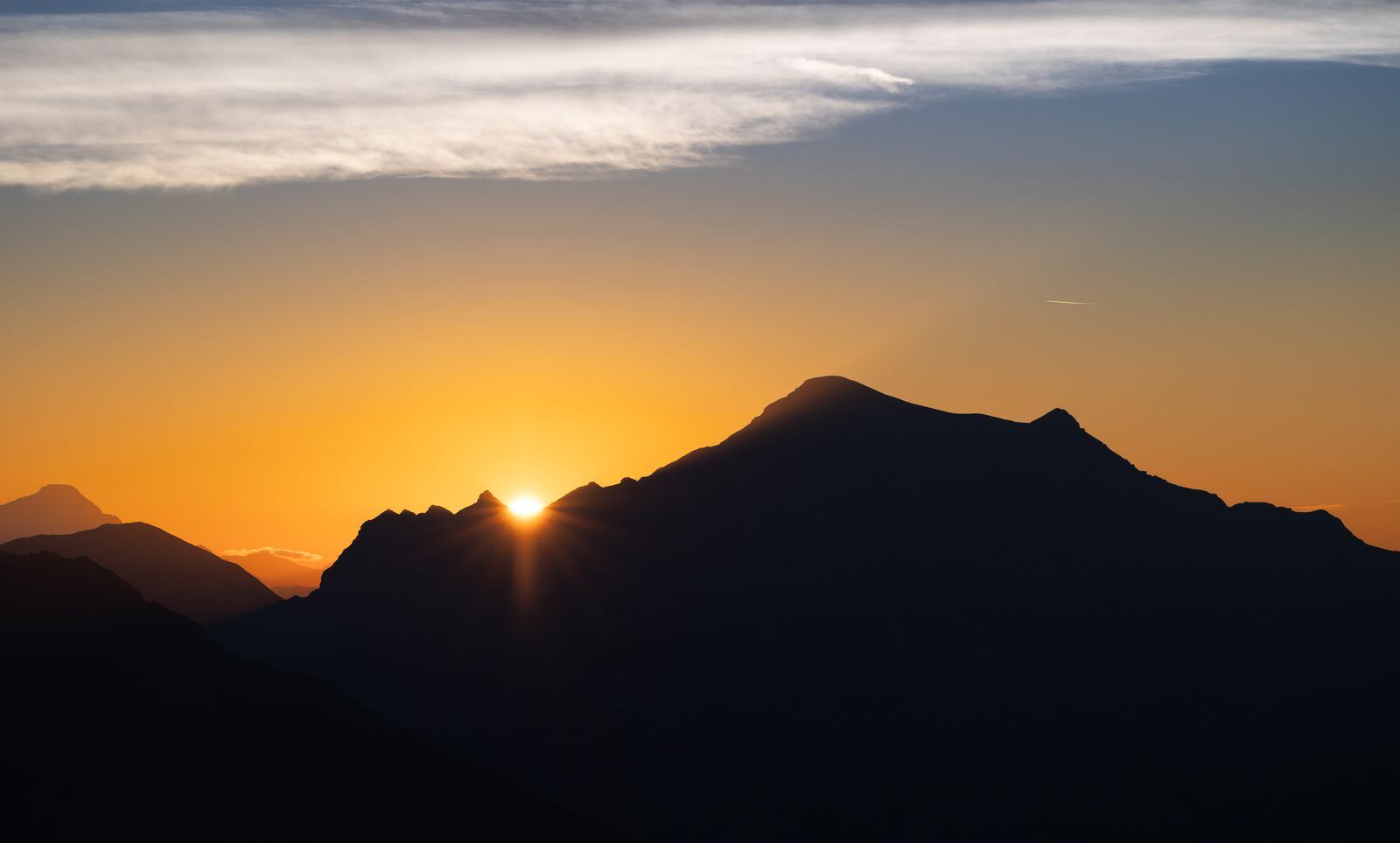
 Photo by Marek Piwnicki on Pexels
You want the Sun to appear exactly behind a peak, maybe with a little sunstar on the edge of the rock. You hike up in the dark, wait for the sunrise time your weather app gave you, and the Sun shows up half an hour later, far to the right, behind a different mountain. Knowing whether the Sun will rise behind a mountain isn’t luck: it comes down to three checks, all of which you can do from home.
Why sunrise isn’t always in the east
The first thing to know is that the Sun rises due east only twice a year, at the March and September equinoxes. For the rest of the year the sunrise point slides along the horizon.
At mid-northern latitudes, around 46° N (the Alps, northern Italy, central France), the swing is large:
- in June the Sun rises in the north-east, about 55 degrees from north;
- in December it rises in the south-east, about 125 degrees from north;
- in March and September it rises in the east, at 90 degrees.
That’s more than 70 degrees of horizon between the June and December sunrises. In practice, a peak that’s lit from the side in summer can sit right in front of the rising Sun in winter, or the other way round.
The speed of that shift changes too. Around the equinoxes the sunrise point moves about half a degree a day, a little more than the width of the Sun: within a week the same peak can go from “Sun dead centre” to “Sun off to the side”. Near the solstices, on the other hand, sunrise barely moves for weeks, so you get many more days for the same alignment.
Check one: direction
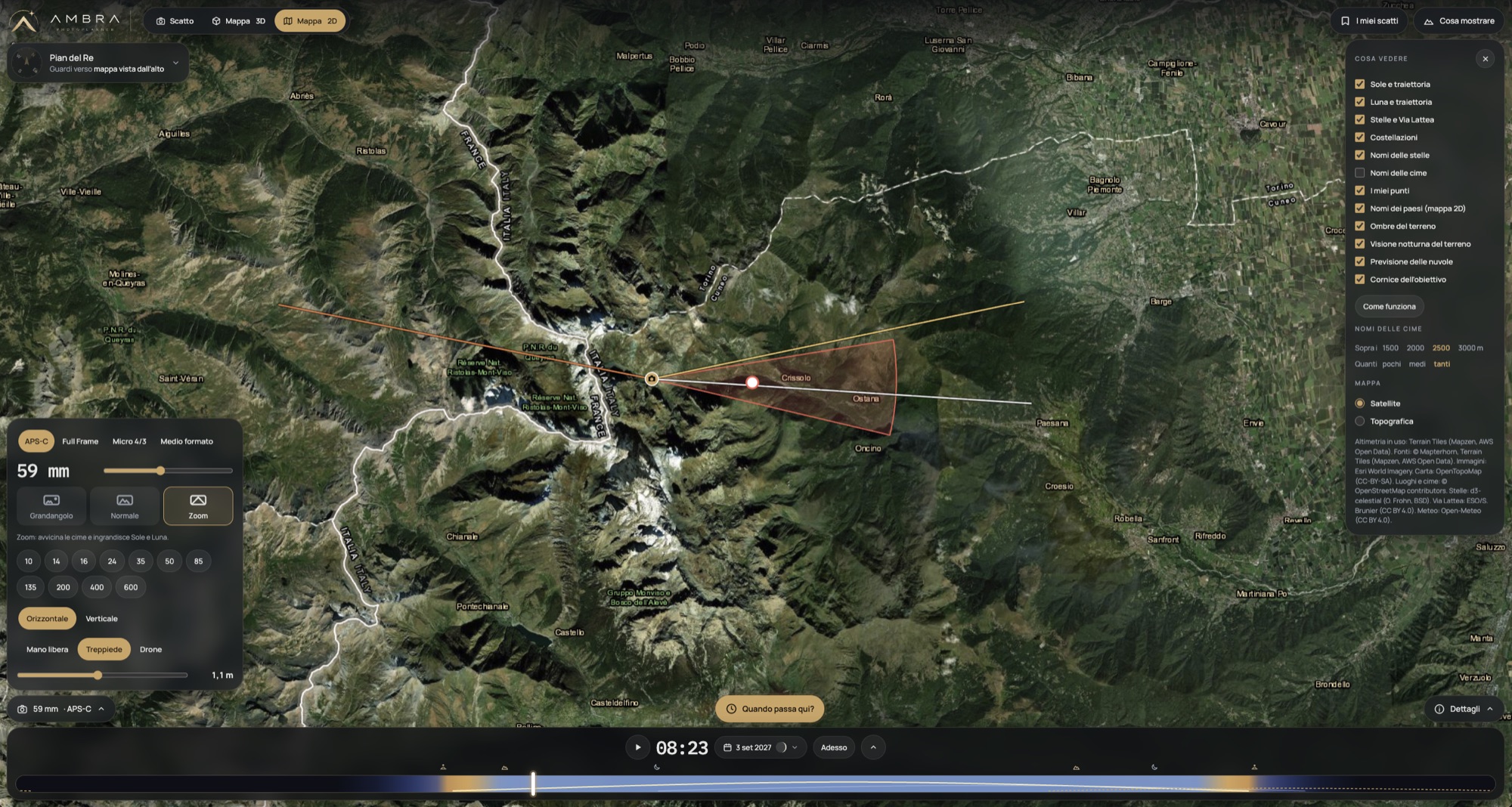
Start by working out which direction the mountain lies from your shooting spot. On a map, draw a line from you to the summit and measure its angle from north: that’s the mountain’s azimuth.
Then compare that number with the sunrise direction on the day you’re interested in. If the peak is at 110 degrees, for example, then with a flat horizon the Sun rises there twice a year: around early November and, symmetrically, around mid-February. A high ridge shifts those dates a little, as we’ll see in a moment.
Remember that the Sun is small: it’s only about half a degree wide. To put it right on the summit you need to be precise; “roughly east” won’t do.
Check two: ridge height
This is where most people go wrong. The sunrise time in weather apps assumes a flat horizon, like the sea. In the mountains the Sun first has to clear the ridge, and that changes two things.
It appears later. The higher the ridge stands in the sky, the longer the Sun takes to get above it. At these latitudes, depending on the season, the newly risen Sun climbs about one degree every 6–7 minutes. A ridge 5 degrees high therefore delays sunrise by a good half hour.
It appears further right. The Sun doesn’t climb straight up but on a slant, drifting south as it rises. At these latitudes it moves roughly one degree to the right for every degree it climbs. If the ridge is 8 degrees high, the Sun will appear about 8 degrees to the right of the “official” sunrise direction.
To estimate the ridge height you need two numbers: how much higher it is than you, and how far away. A couple of examples:
- a ridge 800 metres above you and 4 kilometres away stands about 11 degrees high: the Sun will appear more than an hour after official sunrise;
- the same ridge 10 kilometres away drops to about 4–5 degrees: the delay shrinks to around half an hour.
On location you can do a quick check with your hand: a closed fist at arm’s length covers about 10 degrees.
Check three: the real time
Put direction and height together and you get the information you actually need: when and where the Sun will break over the skyline.
That changes how you plan the morning. If the Sun appears an hour after official sunrise, you can leave later, or use that hour to shoot the distant peaks already catching light while you’re still in shadow. If, on the other hand, the ridge is low and far away, the real time is close to the official one and there’s no slack for delays.
There’s a creative upside too. When the Sun breaks over a ridge it’s already a few degrees up, so the light is stronger than a sunrise over the sea. But the edge of the rock partly hides it, and stopping down to f/11–f/16 gives you that classic sunstar on the skyline.
How to move to line up the Sun with the peak
If the Sun doesn’t rise behind the peak on the day you’ve chosen, you have two options: change the date or change your shooting spot.
Moving works better than you’d think. If the Sun rises to the right of the peak, move left (north, when facing east): from the new spot the peak slides to the right until it sits in front of where the Sun appears. If it rises to the left, do the opposite. The further you are from the peak, the further you need to move, but the smaller the mountain looks next to the Sun. With a telephoto lens from far away, the Sun looks huge beside the summit: that’s how you get those shots where the star dwarfs the skyline.
A few practical tips:
- Check foreground ridges. Sometimes it isn’t the peak that hides the Sun, but a nearby hill you hadn’t noticed.
- Leave a few days of margin. Weather can let you down, so look for a window of dates rather than a single day.
- The same goes for sunset. Just flip the reasoning: the Sun sinks on a slant to the right and disappears before the official time.
How Ambra helps
You can do all of this with a map, a protractor and a table of times. With Ambra you see it directly on the real terrain.
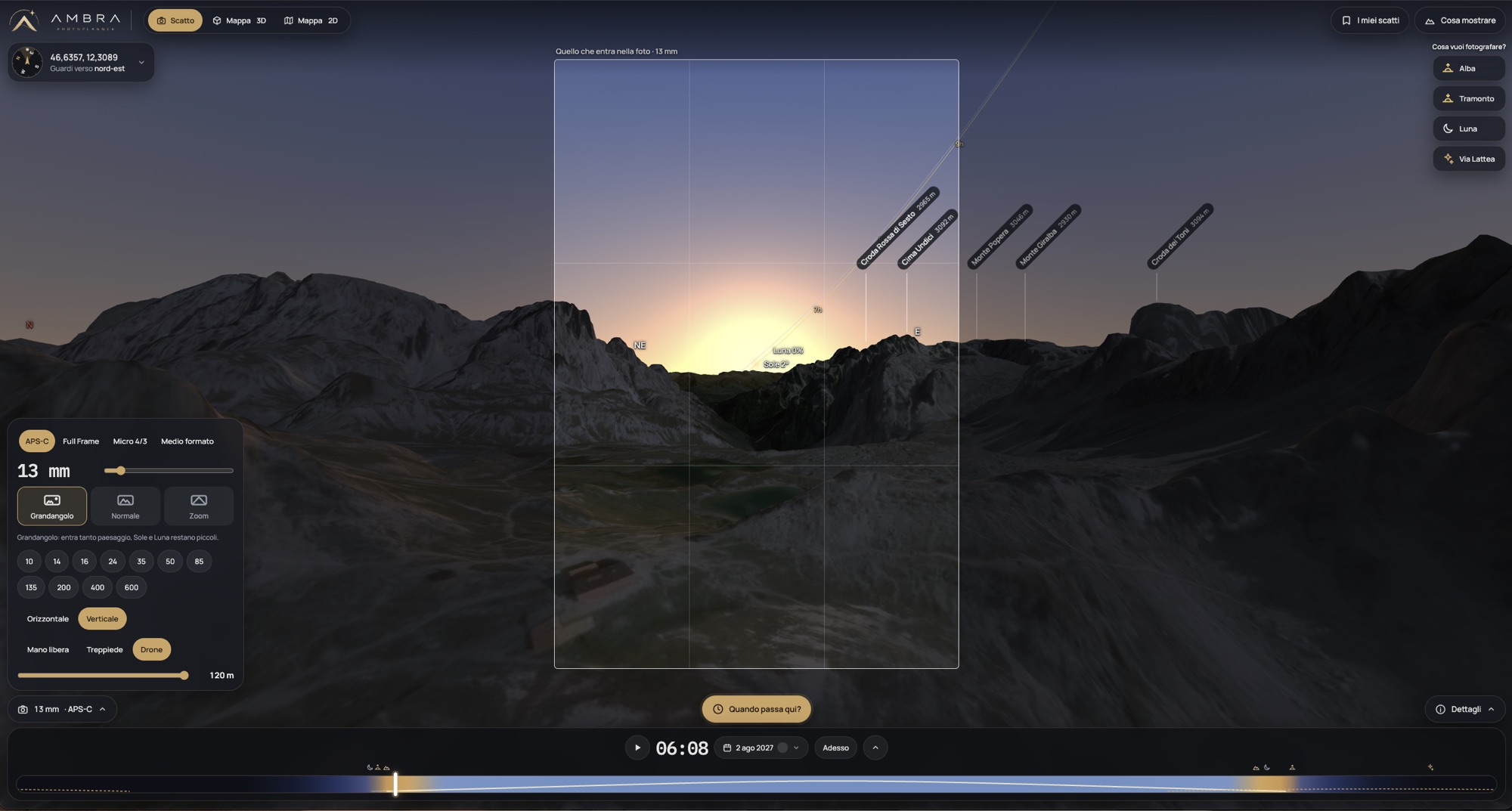
In the shot view you pick where you want to shoot from, set the date and see the arc of the Sun’s path over the real mountains, with times. Lines of sight and the horizon tell you whether a ridge hides the Sun, and the peak names along the skyline help you recognise which mountain you’re looking at. The 2D map shows the sunrise and sunset directions from your shooting spot.
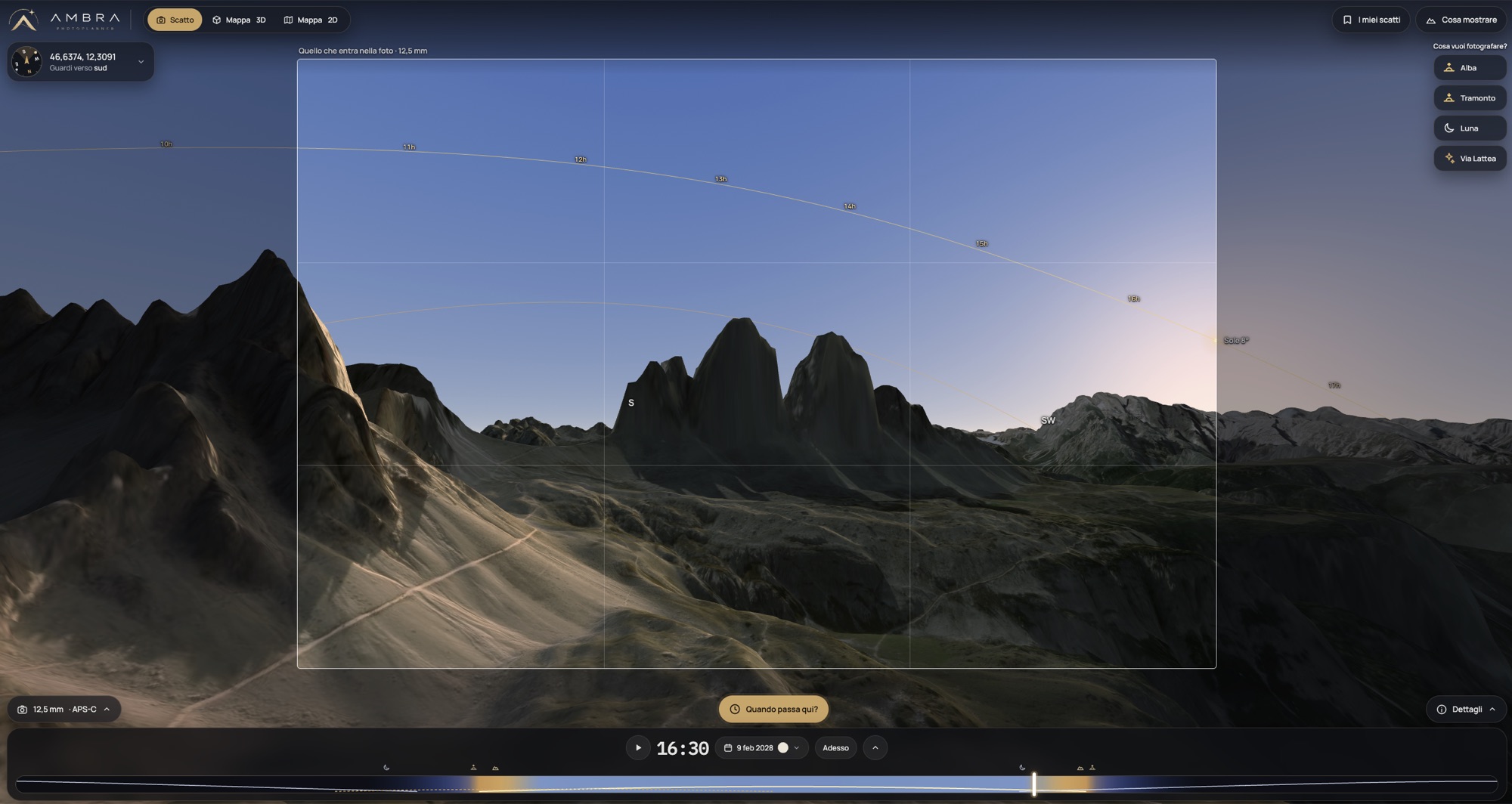
If you’d rather start from the mountain, the When will it line up? feature lists the days and times when the Sun passes the point you’ve framed, and if it doesn’t work from where you are, it suggests a better shooting spot. The same approach works for the Moon and the Milky Way, as we saw in the article on how to plan the Milky Way over a mountain peak.
In short
To know whether the Sun will rise behind a mountain, run three checks. First direction: compare the peak’s azimuth with the sunrise point on your chosen day, remembering that it moves from north-east in summer to south-east in winter. Then ridge height: the higher and closer it is, the later and further right the Sun will appear. Finally the real time, which is what you set your alarm by. If the numbers don’t add up, change the date or step sideways: often a few hundred metres is all it takes.